


In the Media
γ-Tocotrienol Shows Strong Protective Effects Against Muscle Atrophy
A research team led by Distinguished Professor Shih-Min Hsia from the School of Nutrition and Health Sciences, College of Nutrition, Taipei Medical University, has uncovered the protective effects and underlying mechanisms of γ-tocotrienol—a member of the natural vitamin E family—in combating muscle atrophy. Their research was published in Redox Biology, a leading international journal (impact factor 11.9 in 2024; ranked in the top 4.7% of the field of Biochemistry & Molecular Biology). The study offers new scientific insights into inflammation-induced muscle atrophy and highlights promising directions for nutritional intervention.
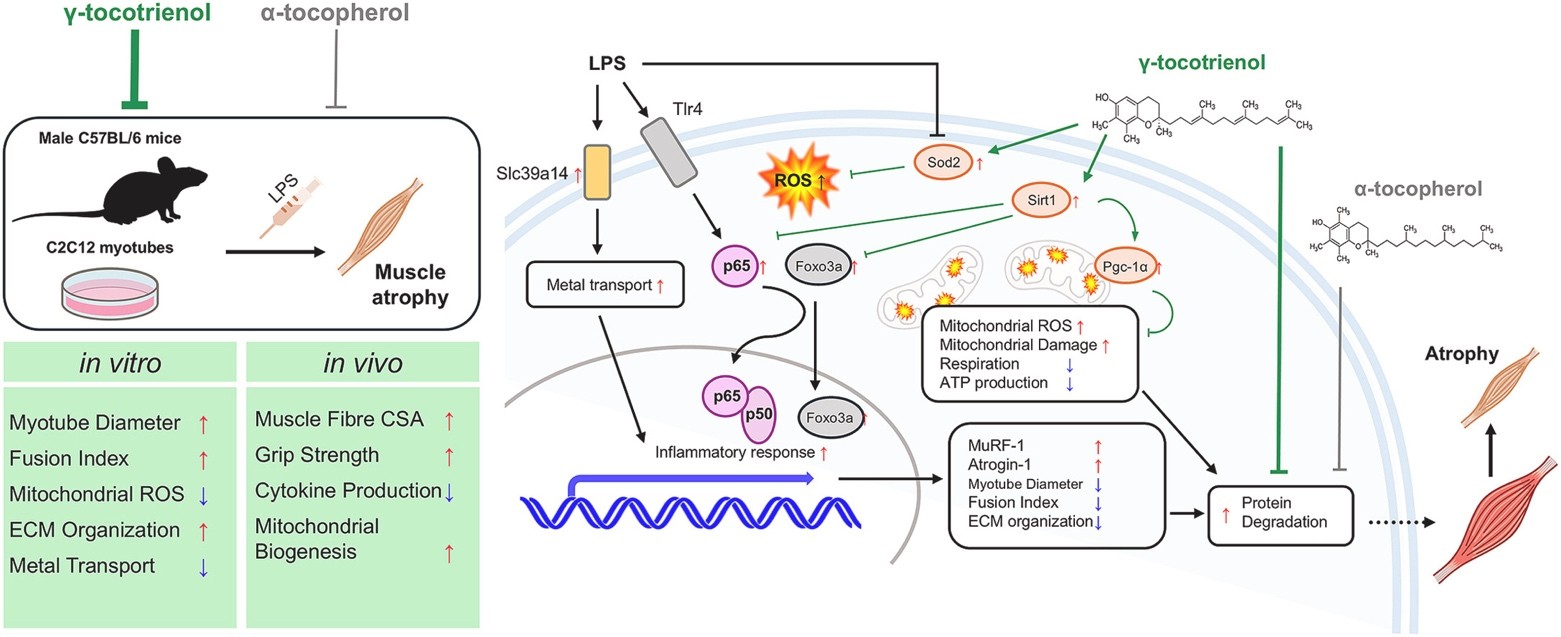
Visual summary of the study
The researchers demonstrated that γ-tocotrienol, a compound found in rice-bran oil, palm oil, and other natural sources, can effectively slow muscle loss through multiple molecular mechanisms. These findings provide a strong scientific basis for preventing aging- and sarcopenia-related diseases.
According to the study, γ-tocotrienol exerts its protective effects through two key pathways. First, it inhibits the generation of reactive oxygen species (ROS), thereby minimizing cellular damage caused by oxidative stress; second, it enhances mitochondrial biogenesis, helping to restore and maintain cellular energy production. Together, these actions help preserve muscle cell structure and function, thereby reducing the risk of inflammation-induced muscle atrophy.
Importantly, experimental results indicated that, compared with traditional α-tocopherol, γ-tocotrienol was more effective at inhibiting MuRF-1 and Atrogin-1, key factors associated with muscle atrophy. Animal models also revealed a significant preservation of muscle mass and strength, demonstrating the superior efficacy of γ-tocotrienol in preventing muscular atrophy.
Given its natural origin and strong safety profile, γ-tocotrienol holds great potential for applications in nutritional intervention and preventative medicine. It may be developed into health foods and specialized medical nutrition products to support muscle health in older adults, postoperative patients, and individuals experiencing prolonged immobilization.
The research team pointed out that this research not only opens new venues for understanding the mechanisms underlying muscle atrophy but also highlights the translational potential of natural nutrients in medical applications. In the future, the team will further investigate the synergistic of γ-tocotrienol with other nutrients and assess its applicability across different muscle atrophy models, continuing to provide a scientific foundation for healthy aging and chronic disease management.
-
Original Article: γ-Tocotrienol attenuates oxidative stress and preserves mitochondrial function in inflammation-induced muscle atrophy
-
Author Profile: Shih-Min Hsia, Distinguished Professor, School of Nutrition and Health Sciences

Shih-Min Hsia, Distinguished Professor, School of Nutrition and Health Sciences