


In the Media
The Hidden Dangers of High-Temperature Cooking: New Discoveries about GE and 3-MCPDE Production Mechanisms in Meats
As high-temperature cooking methods such as roasting, grilling, and frying become increasingly common in modern diets, food scientists are paying closer attention to heat-induced contaminants that may pose health risk. While glycidyl esters (GEs) and 3-monochloropropanediol esters (3-MCPDEs) have long been associated with refined edible oils, emerging research suggests these compounds may also form directly in meat during cooking. To better understand how cooking conditions affect contaminant formation, researchers from Taipei Medical University (TMU) and the University of California, Davis (UC Davis) conducted a pioneering study investigating the relationship between heating conditions, fat composition, and lipid oxidation in meat products.
A research team led by Associate Professor Wei-Ju Lee from the School of Food Safety, College of Nutrition at TMU, in collaboration with Professor Selina C. Wang of UC Davis, has published new findings on the formation of heat-induced contaminants in meat. Their study, “Effects of oven heating on the formation of glycidyl esters and 3-monochloropropanediol esters in various meats”, has been published in the international journal Food Chemistry.
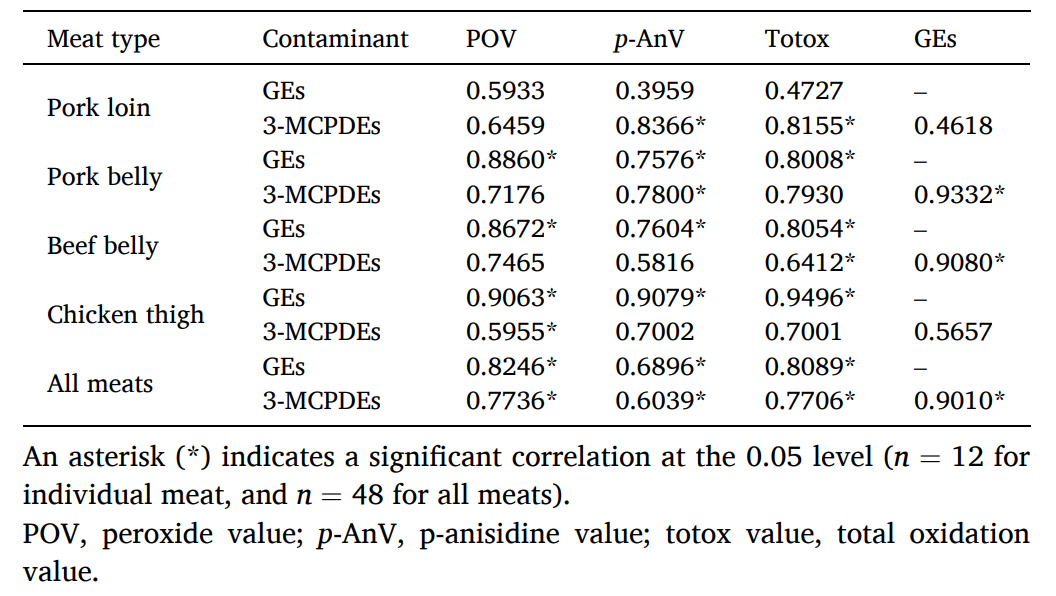
Correlation analyses of glycidyl esters (GEs), 3-monochloropropanediol esters (3-MCPDEs) with oxidative indicators
Previous studies have shown that GEs and 3-MCPDE are commonly found in refined vegetable oils and processed foods containing such oils. These compounds are considered potential carcinogenic contaminants and are primarily formed during the high-temperature deodorization stage of edible oil refining. In recent years, researchers have also discovered that endogenous fats in foods may generate GEs and 3-MCPDEs during cooking and thermal processing. Meat products, in particular, have attracted growing attention; however, the mechanism underlying the formation of these contaminants and the factors influencing their production have remained unclear.
This study is the first to establish quantitative relationships among fat composition, lipid oxidation, and contaminant formation under different heating conditions using real meat products as research samples. By employing actual meat specimens, the study overcomes the limitations of previous studies that focused on vegetable oil models and fills gaps in the literature. The research examined four commonly consumed meats with varying fat contents (pork loin, pork belly, beef belly, and chicken thigh), which were heated in a high-temperature oven to evaluate the effects of different cooking temperatures (150–300°C) and durations (10–30 minutes) on the formation of GEs and 3-MCPDEs.
The results demonstrated that contaminant concentration increased with both heating temperature and cooking duration, reaching peak levels after heating at 300°C for 30 minutes. At the same time, the meat samples experienced substantial moisture loss. The researchers also found positive correlations between fat content, lipid oxidation indicators, and the concentrations of GEs and 3-MCPDEs. In high-fat meat products, the two contaminants were also highly correlated.
These findings confirm that fat content and lipid oxidation are key factors promoting GEs and 3-MCPDEs during the thermal processing of meat products. The study provides important scientific evidence for improving meat preparation safety and offers valuable insights for the development of safer cooking practices.
- Original Article: Effects of oven heating on the formation of glycidyl esters and 3-monochloropropanediol esters in various meats
- Keywords: Moisture content, Fat content, Fatty acid composition, Acid value, Total polar compound, Totox value
- Author Profile: Wei-Ju Lee, Associate Professor from the School of Food Safety, College of Nutrition

Wei-Ju Lee, Associate Professor from the School of Food Safety, College of Nutrition